
AWS vs Azure vs Google Cloud Comparison
Choosing a cloud platform is one of the most important IT decisions for modern businesses.
In 2026, most SMBs rely on cloud infrastructure for storage, applications, and operations.
However, the choice between AWS, Microsoft Azure, and Google Cloud is not always clear.
Each platform offers different strengths in performance, pricing, security, and integrations.
Selecting the wrong provider can lead to unnecessary costs, integration issues, and limited scalability.
Quick Answer: AWS vs Azure vs Google Cloud
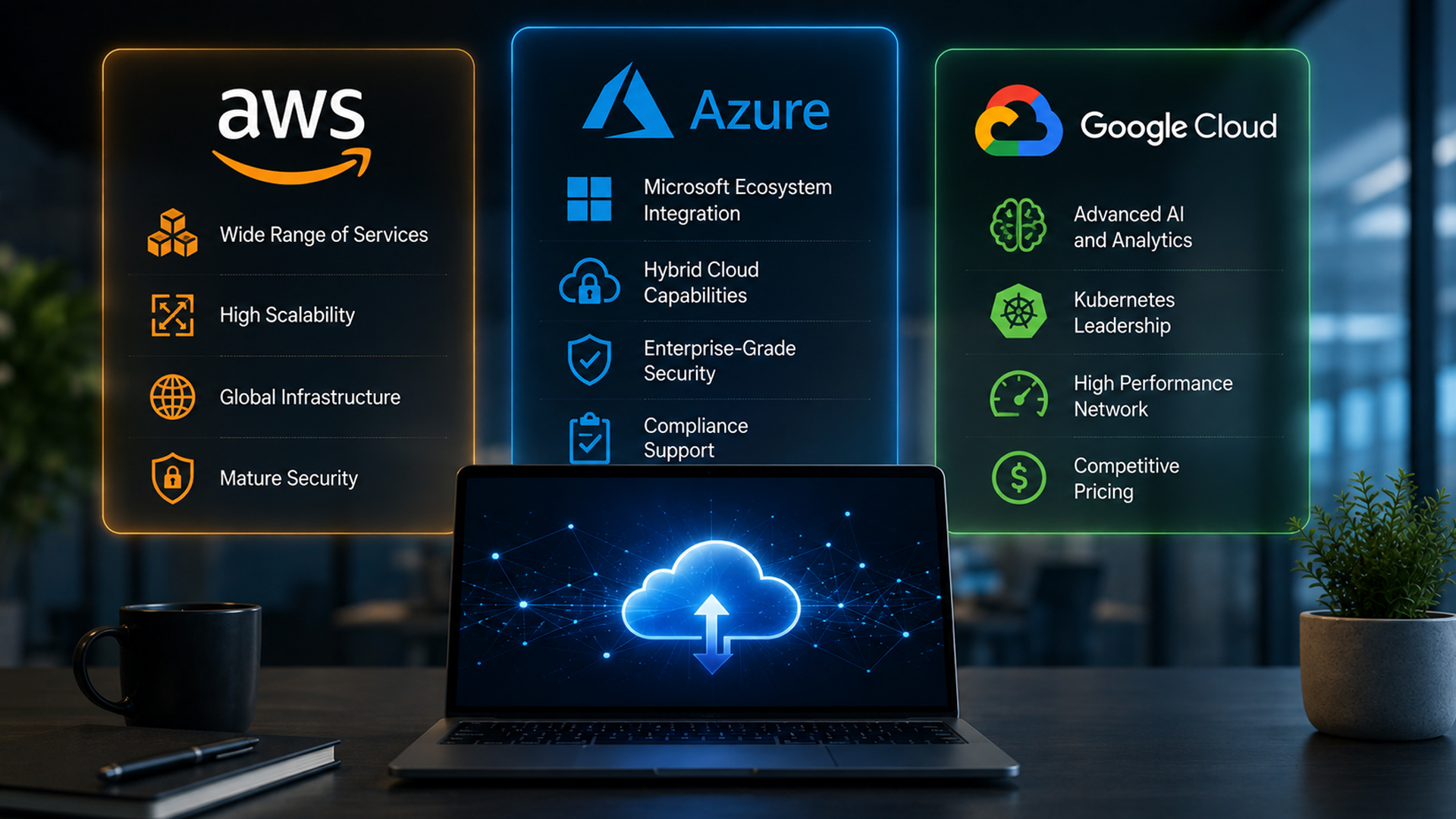
AWS offers the most mature and widely adopted cloud ecosystem
Azure integrates best with Microsoft-based business environments
Google Cloud excels in data analytics and AI capabilities
All three provide strong security and global infrastructure
The best choice depends on business needs and existing systems
Why Cloud Choice Matters in 2026
Cloud platforms are no longer just storage solutions.
They are the foundation of business operations, security, and scalability.
Businesses must consider:
Security and compliance requirements
Integration with existing tools and systems
Cost predictability and scalability
Performance and global availability
A poor cloud decision can lead to long-term operational inefficiencies.
AWS vs Azure vs Google Cloud Breakdown
Amazon Web Services (AWS)
AWS is the most widely used cloud platform globally.
It offers a vast range of services and strong global infrastructure.
Strengths:
Largest service ecosystem
High scalability and flexibility
Strong global availability
Mature security tools
Challenges:
Complex pricing structure
Steeper learning curve for beginners
Microsoft Azure
Azure is deeply integrated with Microsoft tools and enterprise environments.
It is commonly used by businesses already using Microsoft 365 or Windows Server.
Strengths:
Seamless Microsoft ecosystem integration
Strong hybrid cloud capabilities
Enterprise-grade security and compliance
Easy adoption for Microsoft-based organizations
Challenges:
Slightly complex interface for beginners
Some services less mature than AWS
Google Cloud Platform (GCP)
Google Cloud is known for data analytics, AI, and machine learning capabilities.
It is highly efficient for data-driven businesses.
Strengths:
Advanced AI and analytics tools
Strong Kubernetes and container support
Competitive pricing for specific workloads
High-performance networking
Challenges:
Smaller market share compared to AWS and Azure
Fewer enterprise integrations in some industries
MSP Cloud Strategy Approach
Managed Service Providers help businesses choose and manage the right cloud platform based on goals and infrastructure.
MSPs provide:
Cloud assessment and strategy planning
Migration support and execution
Security configuration and compliance setup
Cost optimization and monitoring
Ongoing cloud management and support
Explore managed IT services.
Learn more about cybersecurity solutions.
Tools, Frameworks, and Best Practices
Multi-Cloud Strategy
Using more than one cloud provider for flexibility and redundancy.
Hybrid Cloud Architecture
Combines on-premise systems with cloud infrastructure.
Identity and Access Management
Controls who can access cloud resources securely.
Cost Management Tools
Helps monitor and optimize cloud spending.
Cloud Security Posture Management
Ensures cloud environments remain secure and compliant.
Cost of Choosing the Wrong Cloud Platform
Selecting the wrong provider or architecture can lead to:
Higher operational costs
Poor application performance
Integration challenges
Security configuration issues
Vendor lock-in limitations
Migration between cloud providers can also be expensive and time-consuming.
Step-by-Step Cloud Selection Framework
Step 1: Assessment
Evaluate current systems, applications, and workloads.
Step 2: Requirement Analysis
Identify performance, compliance, and scalability needs.
Step 3: Provider Comparison
Match requirements with AWS, Azure, and Google Cloud capabilities.
Step 4: Implementation Planning
Design architecture and migration strategy.
Step 5: Deployment and Optimization
Deploy workloads and continuously optimize performance and cost.
MSP / Cybersecurity Value in Cloud Selection
MSPs help businesses avoid costly mistakes by aligning cloud platforms with business goals.
Key benefits include:
Reduced complexity in decision-making
Optimized cloud architecture
Stronger security configuration
Better cost control and forecasting
Continuous support and management
Cloud success depends on both platform choice and proper implementation.
Real-World Use Cases
Healthcare
Secure patient data storage and compliance-driven cloud environments.
Finance
Secure transaction processing and high-performance data systems.
Legal
Secure document storage with controlled access and compliance support.
SMB Retail
Scalable cloud systems for inventory and customer management.
SaaS Companies
High-performance cloud infrastructure for application hosting.
Manufacturing
Cloud-based monitoring and supply chain optimization systems.
FAQ
Conclusion
AWS, Azure, and Google Cloud each offer powerful capabilities, but there is no one-size-fits-all solution.
The best choice depends on business needs, existing infrastructure, and long-term goals.
In 2026, cloud strategy is a critical part of business success.
👉 Contact CyberStreams today to design the right cloud architecture for your business.

Ready For A No-Nonsense Approach To IT?
Hire us to set your IT strategy up for sustainable success.
Learn about our proven No-Nonsense approach.
Get an IT roadmap designed specifically for you.
Fearlessly grow your business.
Schedule an Appointment Today
It’s our job to help your business save money, work faster and focus on what is most important. Schedule a 30-minute call to see if we are a good fit to help your organization.
Enter your name and email to get started today.
Featured Posts
AWS vs Azure vs Google Cloud Comparison
Choosing a cloud platform is one of the most important IT decisions for modern businesses.
In 2026, most SMBs rely on cloud infrastructure for storage, applications, and operations.
However, the choice between AWS, Microsoft Azure, and Google Cloud is not always clear.
Each platform offers different strengths in performance, pricing, security, and integrations.
Selecting the wrong provider can lead to unnecessary costs, integration issues, and limited scalability.
Quick Answer: AWS vs Azure vs Google Cloud
AWS offers the most mature and widely adopted cloud ecosystem
Azure integrates best with Microsoft-based business environments
Google Cloud excels in data analytics and AI capabilities
All three provide strong security and global infrastructure
The best choice depends on business needs and existing systems
Why Cloud Choice Matters in 2026
Cloud platforms are no longer just storage solutions.
They are the foundation of business operations, security, and scalability.
Businesses must consider:
Security and compliance requirements
Integration with existing tools and systems
Cost predictability and scalability
Performance and global availability
A poor cloud decision can lead to long-term operational inefficiencies.
AWS vs Azure vs Google Cloud Breakdown
Amazon Web Services (AWS)
AWS is the most widely used cloud platform globally.
It offers a vast range of services and strong global infrastructure.
Strengths:
Largest service ecosystem
High scalability and flexibility
Strong global availability
Mature security tools
Challenges:
Complex pricing structure
Steeper learning curve for beginners
Microsoft Azure
Azure is deeply integrated with Microsoft tools and enterprise environments.
It is commonly used by businesses already using Microsoft 365 or Windows Server.
Strengths:
Seamless Microsoft ecosystem integration
Strong hybrid cloud capabilities
Enterprise-grade security and compliance
Easy adoption for Microsoft-based organizations
Challenges:
Slightly complex interface for beginners
Some services less mature than AWS
Google Cloud Platform (GCP)
Google Cloud is known for data analytics, AI, and machine learning capabilities.
It is highly efficient for data-driven businesses.
Strengths:
Advanced AI and analytics tools
Strong Kubernetes and container support
Competitive pricing for specific workloads
High-performance networking
Challenges:
Smaller market share compared to AWS and Azure
Fewer enterprise integrations in some industries
MSP Cloud Strategy Approach
Managed Service Providers help businesses choose and manage the right cloud platform based on goals and infrastructure.
MSPs provide:
Cloud assessment and strategy planning
Migration support and execution
Security configuration and compliance setup
Cost optimization and monitoring
Ongoing cloud management and support
Explore managed IT services.
Learn more about cybersecurity solutions.
Tools, Frameworks, and Best Practices
Multi-Cloud Strategy
Using more than one cloud provider for flexibility and redundancy.
Hybrid Cloud Architecture
Combines on-premise systems with cloud infrastructure.
Identity and Access Management
Controls who can access cloud resources securely.
Cost Management Tools
Helps monitor and optimize cloud spending.
Cloud Security Posture Management
Ensures cloud environments remain secure and compliant.
Cost of Choosing the Wrong Cloud Platform
Selecting the wrong provider or architecture can lead to:
Higher operational costs
Poor application performance
Integration challenges
Security configuration issues
Vendor lock-in limitations
Migration between cloud providers can also be expensive and time-consuming.
Step-by-Step Cloud Selection Framework
Step 1: Assessment
Evaluate current systems, applications, and workloads.
Step 2: Requirement Analysis
Identify performance, compliance, and scalability needs.
Step 3: Provider Comparison
Match requirements with AWS, Azure, and Google Cloud capabilities.
Step 4: Implementation Planning
Design architecture and migration strategy.
Step 5: Deployment and Optimization
Deploy workloads and continuously optimize performance and cost.
MSP / Cybersecurity Value in Cloud Selection
MSPs help businesses avoid costly mistakes by aligning cloud platforms with business goals.
Key benefits include:
Reduced complexity in decision-making
Optimized cloud architecture
Stronger security configuration
Better cost control and forecasting
Continuous support and management
Cloud success depends on both platform choice and proper implementation.
Real-World Use Cases
Healthcare
Secure patient data storage and compliance-driven cloud environments.
Finance
Secure transaction processing and high-performance data systems.
Legal
Secure document storage with controlled access and compliance support.
SMB Retail
Scalable cloud systems for inventory and customer management.
SaaS Companies
High-performance cloud infrastructure for application hosting.
Manufacturing
Cloud-based monitoring and supply chain optimization systems.
FAQ
Conclusion
AWS, Azure, and Google Cloud each offer powerful capabilities, but there is no one-size-fits-all solution.
The best choice depends on business needs, existing infrastructure, and long-term goals.
In 2026, cloud strategy is a critical part of business success.
👉 Contact CyberStreams today to design the right cloud architecture for your business.
Enroll in Our Email Course

Learn How a No-Nonsense IT Strategy Benefits Your ComBullet listpany:
Strategies to allocate your IT budget efficiently
Enhance cybersecurity defenses on a bButtonudget
Ensure your technology investments continue to serve your business as it grows
Headquarters
Seattle Office: 951 Industry Dr,
Seattle, WA 98188,
United States
Austin Office
500 E St Johns Ave, Ste 2.620,
Austin, TX 78752, United States
Bellevue Office
11900 NE 1st St, Bellevue,
WA 98005, United States
San Jose Office
2150 N. 1st St., Suite 400, San Jose,
CA 95131, United States
San Diego Office
1111 6th Avenue, San Diego,
CA 92101, United States
© Copyright 2026 CyberStreams. Built in partnership with Tech Pro Marketing. | Privacy Policy


