We use cookies to improve your experience on our site. By using our site, you consent to the use of cookies. Rejecting cookies will prevent non-essential cookies from loading.
Blog
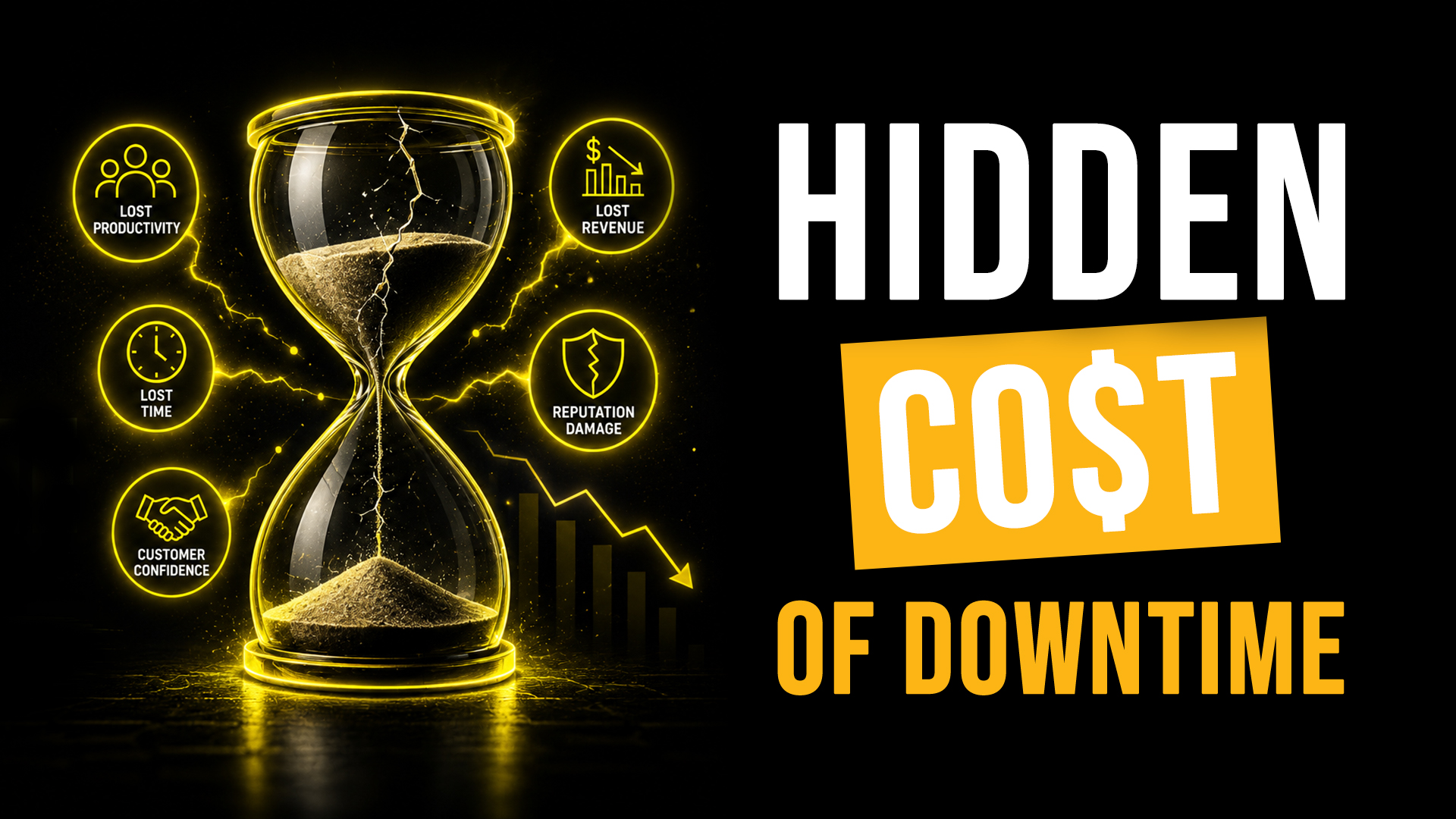
The Hidden Cost of Downtime Most Leaders Never Calculate
Every business owner knows downtime is bad. What most don't realize is how bad, because they're only counting the obvious number: the hours the system was down.
That's the wrong number.
The real cost of downtime stretches well beyond the IT ticket. It lives in your payroll, your pipeline, your customer relationships, and your reputation. Most leaders never add it all up, and that gap in thinking is exactly what makes downtime so expensive.
Here's what the full picture actually looks like.
Lost Productivity: You're Paying People to Wait
When systems go down, your team doesn't clock out. They stay at their desks, unable to do their jobs, while the payroll clock keeps running.
A team of 20 people earning an average of $35 per hour sits idle for four hours. That's $2,800, gone, before you've even called anyone for help. Scale that up to a mid-sized business, stretch the outage past business hours into the recovery window, and that number climbs fast.
What makes this worse is that productivity doesn't snap back the moment systems are restored. There's a recovery lag. Files need to be tracked down. Incomplete work has to be rebuilt. People need to re-orient after the disruption. Studies consistently show that after a significant outage, full productivity doesn't return for hours, sometimes days.
You don't see that cost on an invoice. But it's real.
Lost Revenue: The Sales That Never Happened
Downtime doesn't pause your business, it actively costs you money.
If your team can't access your CRM, proposals don't go out. If your phone system is down, client calls go unanswered. If your e-commerce or client portal is offline, transactions don't happen. Every hour of unavailability is an hour where revenue-generating activity stops, while your fixed costs keep running.
For service businesses, the math is straightforward: take your average hourly revenue and multiply it by the duration of the outage. For most small and mid-sized companies, a single half-day outage can cost tens of thousands of dollars in missed or delayed revenue. For businesses with recurring client deadlines, the cost is compounded further by rush recovery efforts and overtime.
And that's just the revenue you can count. The deals that stall because a prospect couldn't reach you, the clients who quietly decided not to renew, those numbers are harder to track, but they're just as real.
Reputation: Harder to Rebuild Than a Server
Here's the cost that keeps business owners up at night, and the one that's almost never included in any downtime calculation.
Trust is built slowly and lost quickly. When your systems are down, your clients notice. They experience delays, missed responses, and broken commitments. They don't see the IT ticket or the frantic recovery effort behind the scenes. They see that your business was unreliable when they needed it.
Some will be understanding. Others will quietly begin looking at your competitors.
According to research from Uptime Institute, 25% of organizations that experience significant downtime report lasting damage to their business reputation. That's not a temporary PR problem. That's a structural wound that affects renewal rates, referrals, and the lifetime value of your client relationships.
Reputation isn't a soft metric. It's your pipeline.
Customer Confidence: The Quiet Churn You Won't See Coming
There's a difference between a customer who complains and a customer who leaves without saying a word.
When downtime affects client-facing services, you'll often hear from the loudest voices. You'll handle those conversations, resolve the immediate issue, and assume the matter is closed. What you won't see is the quieter erosion of confidence happening beneath the surface.
Clients who experience repeated outages or slow recovery times don't always escalate. They wait for their contract renewal and make a different decision. They refer fewer people. They give lukewarm reviews instead of enthusiastic ones.
That erosion of confidence is cumulative. Each incident adds to a mental ledger that clients are keeping, whether consciously or not. By the time it shows up in your churn rate, the damage was done months earlier.
The Calculation Most Leaders Skip
When a business owner hears "four-hour outage," they often think about the cost of the fix. The technician's time. The hardware replacement. Maybe a few angry emails.
What they should be calculating is this:
Hours of employee idle time, multiplied by loaded labor cost
Revenue lost or delayed during the outage window
Recovery time after systems come back online
Client-facing commitments that were missed or delayed
Long-term impact on client retention and referrals
Add those up, and a four-hour outage that seemed like a $500 problem is often a $15,000 to $50,000 problem, depending on the size and nature of your business.
That changes the conversation entirely.
What This Means for How You Think About IT
The businesses that feel downtime least are the ones that invested in prevention, not reaction.
Proactive managed IT isn't a cost center. It's insurance with a daily dividend. When your infrastructure is monitored, patched, and backed up consistently, outages become rare rather than routine. When they do happen, recovery is measured in minutes, not hours.
At CyberStreams, this is exactly what we built our model around. Flat-fee managed IT means we're incentivized to keep your systems running, because your problems become our problems. Our team monitors your infrastructure around the clock, responds within 90 seconds, and works to resolve issues before they become outages.
The hidden cost of downtime is only hidden until you add it up. Once you do, the value of doing IT right becomes obvious.

Mat Kordell | Founder & CEO | CyberStreams
A reliable and engaged partner in the IT support and services sector is crucial for achieving consistent growth through effective technological strategies. Mat Kordell, Founder & CEO of CyberStreams, is dedicated to assisting clients in optimizing their technology for a competitive edge. At CyberStreams, Mat leads a team focused on delivering outstanding IT security and services. Drawing on his wealth of experience and practical knowledge, Mat ensures that clients receive comprehensive support and direction for their IT security projects. With CyberStreams as your partner, you'll have the resources to enhance your business systems and thrive in today's competitive business environment.
Ready For A No-Nonsense Approach To IT?
Hire us to set your IT strategy up for sustainable success.
Learn about our proven No-Nonsense approach.
Get an IT roadmap designed specifically for you.
Fearlessly grow your business.
Schedule an Appointment Today
It’s our job to help your business save money, work faster and focus on what is most important. Schedule a 30-minute call to see if we are a good fit to help your organization.
Enter your name and email to get started today.
Featured Posts
The Hidden Cost of Downtime Most Leaders Never Calculate
Every business owner knows downtime is bad. What most don't realize is how bad, because they're only counting the obvious number: the hours the system was down.
That's the wrong number.
The real cost of downtime stretches well beyond the IT ticket. It lives in your payroll, your pipeline, your customer relationships, and your reputation. Most leaders never add it all up, and that gap in thinking is exactly what makes downtime so expensive.
Here's what the full picture actually looks like.
Lost Productivity: You're Paying People to Wait
When systems go down, your team doesn't clock out. They stay at their desks, unable to do their jobs, while the payroll clock keeps running.
A team of 20 people earning an average of $35 per hour sits idle for four hours. That's $2,800, gone, before you've even called anyone for help. Scale that up to a mid-sized business, stretch the outage past business hours into the recovery window, and that number climbs fast.
What makes this worse is that productivity doesn't snap back the moment systems are restored. There's a recovery lag. Files need to be tracked down. Incomplete work has to be rebuilt. People need to re-orient after the disruption. Studies consistently show that after a significant outage, full productivity doesn't return for hours, sometimes days.
You don't see that cost on an invoice. But it's real.
Lost Revenue: The Sales That Never Happened
Downtime doesn't pause your business, it actively costs you money.
If your team can't access your CRM, proposals don't go out. If your phone system is down, client calls go unanswered. If your e-commerce or client portal is offline, transactions don't happen. Every hour of unavailability is an hour where revenue-generating activity stops, while your fixed costs keep running.
For service businesses, the math is straightforward: take your average hourly revenue and multiply it by the duration of the outage. For most small and mid-sized companies, a single half-day outage can cost tens of thousands of dollars in missed or delayed revenue. For businesses with recurring client deadlines, the cost is compounded further by rush recovery efforts and overtime.
And that's just the revenue you can count. The deals that stall because a prospect couldn't reach you, the clients who quietly decided not to renew, those numbers are harder to track, but they're just as real.
Reputation: Harder to Rebuild Than a Server
Here's the cost that keeps business owners up at night, and the one that's almost never included in any downtime calculation.
Trust is built slowly and lost quickly. When your systems are down, your clients notice. They experience delays, missed responses, and broken commitments. They don't see the IT ticket or the frantic recovery effort behind the scenes. They see that your business was unreliable when they needed it.
Some will be understanding. Others will quietly begin looking at your competitors.
According to research from Uptime Institute, 25% of organizations that experience significant downtime report lasting damage to their business reputation. That's not a temporary PR problem. That's a structural wound that affects renewal rates, referrals, and the lifetime value of your client relationships.
Reputation isn't a soft metric. It's your pipeline.
Customer Confidence: The Quiet Churn You Won't See Coming
There's a difference between a customer who complains and a customer who leaves without saying a word.
When downtime affects client-facing services, you'll often hear from the loudest voices. You'll handle those conversations, resolve the immediate issue, and assume the matter is closed. What you won't see is the quieter erosion of confidence happening beneath the surface.
Clients who experience repeated outages or slow recovery times don't always escalate. They wait for their contract renewal and make a different decision. They refer fewer people. They give lukewarm reviews instead of enthusiastic ones.
That erosion of confidence is cumulative. Each incident adds to a mental ledger that clients are keeping, whether consciously or not. By the time it shows up in your churn rate, the damage was done months earlier.
The Calculation Most Leaders Skip
When a business owner hears "four-hour outage," they often think about the cost of the fix. The technician's time. The hardware replacement. Maybe a few angry emails.
What they should be calculating is this:
Hours of employee idle time, multiplied by loaded labor cost
Revenue lost or delayed during the outage window
Recovery time after systems come back online
Client-facing commitments that were missed or delayed
Long-term impact on client retention and referrals
Add those up, and a four-hour outage that seemed like a $500 problem is often a $15,000 to $50,000 problem, depending on the size and nature of your business.
That changes the conversation entirely.
What This Means for How You Think About IT
The businesses that feel downtime least are the ones that invested in prevention, not reaction.
Proactive managed IT isn't a cost center. It's insurance with a daily dividend. When your infrastructure is monitored, patched, and backed up consistently, outages become rare rather than routine. When they do happen, recovery is measured in minutes, not hours.
At CyberStreams, this is exactly what we built our model around. Flat-fee managed IT means we're incentivized to keep your systems running, because your problems become our problems. Our team monitors your infrastructure around the clock, responds within 90 seconds, and works to resolve issues before they become outages.
The hidden cost of downtime is only hidden until you add it up. Once you do, the value of doing IT right becomes obvious.
Mat Kordell | Founder & CEO | CyberStreams
A reliable and engaged partner in the IT support and services sector is crucial for achieving consistent growth through effective technological strategies. Mat Kordell, Founder & CEO of CyberStreams, is dedicated to assisting clients in optimizing their technology for a competitive edge. At CyberStreams, Mat leads a team focused on delivering outstanding IT security and services. Drawing on his wealth of experience and practical knowledge, Mat ensures that clients receive comprehensive support and direction for their IT security projects. With CyberStreams as your partner, you'll have the resources to enhance your business systems and thrive in today's competitive business environment.
Enroll in Our Email Course

Learn How a No-Nonsense IT Strategy Benefits Your ComBullet listpany:
Strategies to allocate your IT budget efficiently
Enhance cybersecurity defenses on a bButtonudget
Ensure your technology investments continue to serve your business as it grows

Offices
Seattle Office: 951 Industry Drive, Seattle WA 98188
Austin Office: 305 E Huntland Dr. #602, Austin, TX 78752
© Copyright 2026 CyberStreams. Built in partnership with Tech Pro Marketing. | Privacy Policy


